Conveyor Belt Press Rollers: Function and Selection
2026-11-04 16:51:12
Belt press rollers are one of the few conveyor components whose job is to push down rather than support. They sit above the belt and apply a controlled downward load, and they exist because a belt in certain conditions will not stay where the designer intended. It is a small, cheap part that solves problems which otherwise get answered with structural modification.
What Problem They Solve
A loaded belt normally sits in its trough and stays there. Under particular conditions it does not: at high speed on a convex vertical curve, the belt can lift off its idlers; on a steep incline with a light load, the belt can flap; and at a transfer point where material arrives with vertical velocity, the belt can be lifted momentarily and lose contact with the support beneath it.
In each case the result is the same — loss of support, material spillage, dust, and accelerated wear where the belt contacts whatever is above it. A press roller restrains the belt and restores contact with the carrying idlers underneath.
Where They Are Installed
The most common position is on the approach to a convex curve, where the belt's own tension tends to lift it away from the idler line. A second common position is immediately downstream of a loading point, where material impact can make the belt bounce. A third is on inclined conveyors where the belt is lightly loaded and prone to flutter.
They are also used ahead of skirts and sealing arrangements where the belt has to be held flat for the seal to work, and on reversing or shuttle conveyors where the belt changes direction and the support geometry changes with it.
How the Pressure Is Applied
A press roller is mounted on a frame above the belt, with the roller bearing down on the top cover. The mounting usually provides some adjustment so the contact load can be set, and often a spring or weighted arm so the load stays roughly constant as the belt moves and the roller wears.
Setting that load is the whole art. Too little and the roller does nothing. Too much and it presses the belt hard against the idlers below, which increases resistance, wears the top cover in a stripe, and can damage the belt carcass at the edges where the load concentrates. The right setting is the minimum that keeps the belt seated, found by running and observing rather than by calculation.
Roller Construction and Surface
Press rollers are built like idlers with an additional structural requirement: they carry a radial load applied from outside rather than from the belt beneath, so the shaft and bearing arrangement must be designed for that direction of loading. Bearings are usually the same type as idler bearings but sized for the applied pressure.
Surface treatment matters. A plain steel roller in contact with the top cover of a loaded belt will polish and then wear the cover. Rubber covering is common because it protects the belt, provides friction without slip, and reduces noise. On belts carrying sticky material, a disc or segmented surface can be used so the roller does not accumulate material on its own face, which would otherwise create an out-of-round roller pressing unevenly on the belt.
Selection Parameters
Belt width and the roller face length come first; the face should be long enough to cover the belt width but not so long that it overhangs the structure. Roller diameter follows from the required stiffness over the span — a small diameter roller on a wide belt will deflect, and a deflecting press roller applies more pressure at the centre than at the edges.
Then the applied load, the mounting arrangement, and the clearance above the belt. On a retrofit, the clearance is often the limiting factor, and a compact mounting with a smaller roller may be the only option that fits.
Mistakes in Application
The main one is using press rollers to fix a tracking problem. They restrain vertical movement, not lateral. A belt running off centre will continue to run off centre with a press roller on top of it, and the added pressure will simply wear the cover faster.
The second is over-pressing to solve spillage at a skirt. If material is escaping under the skirt rubber, the answer is usually better skirt sealing or a supported belt at the loading zone, not more downward force. Pressing harder deforms the belt and opens the seal further along the conveyor.
Sourcing
Because press rollers are usually retrofit items, they are almost always custom. Send the supplier the belt width, the available clearance, the mounting points, and the reason for fitting them — a manufacturer who understands the application can advise on roller diameter and covering rather than simply machining to a sketch that may not solve the problem.
Standard and non-standard structures both appear here, so a supplier able to fabricate the mounting as well as the roller is usually the practical choice.
References
Conveyor Equipment Manufacturers Association (CEMA), Belt Conveyors for Bulk Materials, 7th Edition, 2014.
ISO 5048:1989, Continuous mechanical handling equipment — Belt conveyors with carrying idlers — Calculation of operating power and tensile forces, International Organization for Standardization.
DIN 22101:2011, Continuous conveyors — Belt conveyors for loose bulk materials — Basis for calculation and dimensioning, Deutsches Institut für Normung.
AS 1755-2000, Conveyors — Safety requirements, Standards Australia.
ASME B20.1-2021, Safety Standard for Conveyors and Related Equipment, American Society of Mechanical Engineers.
Author: Michael Trent — Technical Content Team, Conveyor Components Division
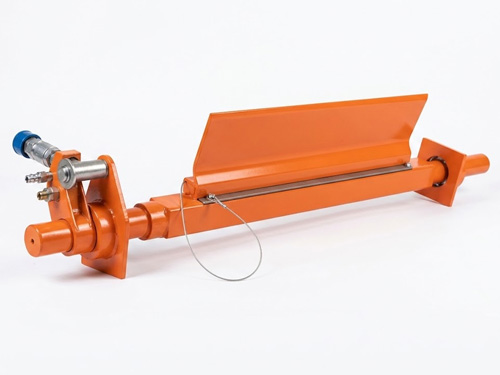
Heavy-Duty Primary Belt Cleaner Heavy-Duty Primary Belt Cleaners are robust conveyor belt c...
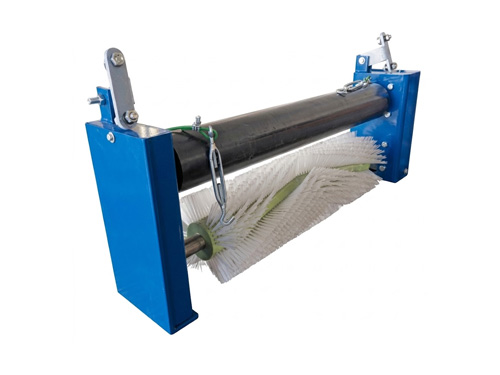
Self-Driven Rotary Brush Belt Cleaner Self-Driven Rotary Brush Belt Cleaners are specialize...
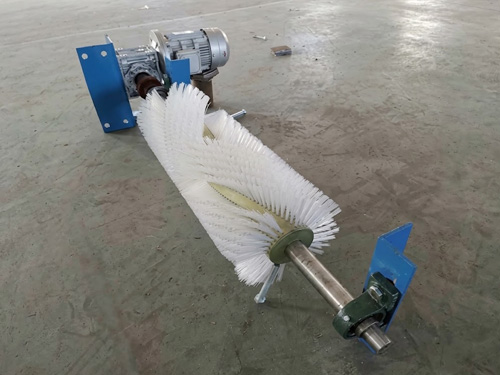
Brush Belt Cleaners in Various Models Brush Belt Cleaners are specialized conveyor belt cle...
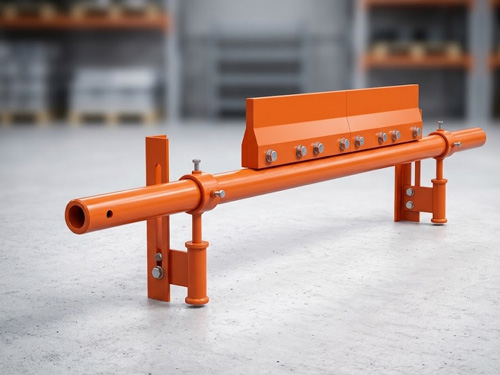
Secondary Conveyor Belt Cleaner Secondary Conveyor Belt Cleaners are designed to remove res...